Knowledge Pillar 01 · AI search for hotels
SEO vs GEO for hotels: same page, two scoreboards
SEO finds you. GEO decides whether an AI answer can use you. Same stay-intent page - two scoreboards, one standard of truth.
What are the key points in one minute?
- SEO and GEO are not rivals. They are two scoreboards reading the same hotel page. SEO asks whether you can be found and ranked in classic results. GEO asks whether you can be retrieved, extracted, and attributed inside a synthesized answer.
- Academic GEO is real, not a rebrand. Aggarwal et al. (KDD 2024) formalized Generative Engine Optimization, released GEO-bench (~10,000 queries), and showed that adding statistics, quotations, and source citations can raise source visibility on Position-Adjusted Word Count by up to ~40% on GEO-bench in that lab setting (Subjective Impression lifts were smaller, roughly 15-30%) - while keyword stuffing failed as a GEO strategy on GEO-bench PAWC (and was about 10% worse than baseline on PAWC in their Perplexity.ai file-upload evaluation, not on Subjective Impression).
- Retrieval still gates the game. Gao et al.'s RAG survey maps how systems that retrieve external documents can ground generation - a common pattern, not a measured law for every AI answer product, and not a teardown of AI Overviews. Puerto et al. (NeurIPS 2025 Datasets & Benchmarks, C-SEO Bench) then showed that, for citation ranking on white-hat transforms, placing a source earlier in the LLM's retrieved context usually beats fashionable conversational SEO rewrites of the page text (English, proprietary model scaffolds - not a Google AI Overviews field test).
- Those papers do not cancel each other. Aggarwal primarily measures share of answer substance; Puerto primarily measures citation ranking. A page can earn more of the answer's words without leaping citation order. Complementary constraints, not a food fight.
- Clicks are a noisier scoreboard. Pew (July 2025) found traditional result clicks in 8% of visits when an AI summary appeared vs 15% without - and only ~1% clicked a source inside the summary.
- Practitioner translation (not a hotel trial): build stay-intent pages that are crawlable and relevant (SEO), and answer-shaped, fact-dense, and attributable (GEO). The dual-board checklist later in this piece is an editorial rubric we use - not a validated instrument from Aggarwal, Puerto, or anyone else.
Hotel marketing teams are being sold a false choice: keep doing SEO, or abandon it for "GEO." Both pitches are incomplete. The useful truth is quieter and more operational:
You are still writing one page. The web is now grading that page on two scoreboards.
Scoreboard one is classic search: can a crawler fetch you, can a ranker place you, will a human click you? Scoreboard two is generative search: can a retriever pick you up, can a model extract a clean claim from you, will the answer name or link you when a guest asks where to stay for the concert, the race, the wedding weekend?
This piece is the companion to our guide on how hotels get cited in ChatGPT and AI Overviews. That article walks the citation funnel. This one settles the category confusion: what SEO still measures, what GEO adds, where the evidence agrees, where it only appears to argue with itself, and how to run both boards without two websites.
The job here is reconciliation. Not "SEO is dead." Not "GEO is fake." One operating thesis from five sources hotel teams usually hear in fragments: Aggarwal, Puerto, Liu, Gao, and Pew.
External validity: Aggarwal, Puerto, Liu, Gao, and Pew constrain mechanisms and metrics in non-hotel or mixed-domain settings. Hotel page types, dual audits, score bands, and 30-day walks later in this piece are intentStay craft layered on top. Transfer the mechanisms; do not treat the rituals as science.
Is GEO just SEO with a new acronym?
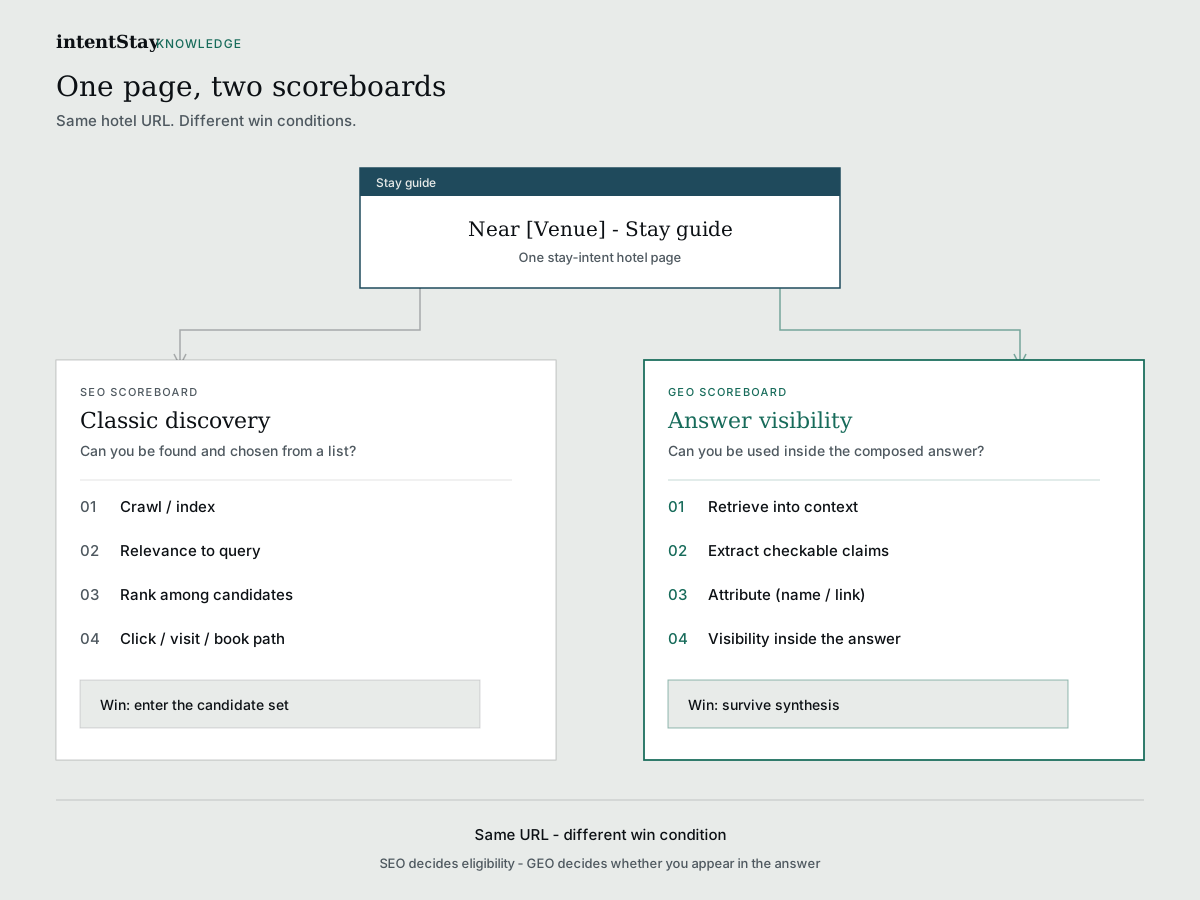
| Board | Core question | Primary signals |
|---|---|---|
| SEO | Can we be found and ranked? | Crawl, relevance, links, CTR / visits |
| GEO | Can we be used inside the answer? | Extractability, attribution, share of answer |
| Joint | Can one page win both? | Stay-intent briefing that is eligible and quotable |
The acronym explosion is real. GEO, AEO, AIO, C-SEO - consultants mint labels faster than hotels can update a parking paragraph. Skepticism is healthy. Acronyms are not evidence. What is evidence is a measurable change in how answers are assembled.
Classic SEO grew up around a ranked list. A page's "win" was mostly ordinal: position 1 beats position 7. Aggarwal and colleagues put the contrast cleanly: in traditional search, average ranking is a workable impression metric because the interface is a linear list. Generative engines synthesize multiple sources into one response and embed citations with different lengths, positions, and roles. A source can be "visible" by owning the first factual clause, by supplying the only usable distance figure, or by being paraphrased without a click. That is not the same scoreboard as "we're #3 for hotels near stadium."
GEO is not "SEO but we said AI." It is optimizing for answer-level visibility - attribution, extractability, and influence inside a composed response - while SEO remains eligibility, crawlability, relevance, and competitive discovery.
If someone tells you GEO replaces SEO, they are selling a story the better academic work no longer supports. If someone tells you GEO is fake, they are ignoring a published KDD framework, a ~10,000-query benchmark, and a growing body of evaluation on how generative search cites (or fails to cite) the open web. The honest middle is less marketable and more useful: two readouts, one artifact.
What does the SEO scoreboard still measure for hotels?
Before anyone romanticizes AI answers, remember what still has to be true. A crawler has to fetch the page. Indexing systems have to keep it. Intent match has to compete with OTAs, city guides, venue pages, and chain microsites. Links and brand mentions still separate durable entities from lonely claims. Google's helpful-content guidance still centers people-first usefulness and E-E-A-T - not production theater.
For hotels, the SEO scoreboard's practical questions look like this:
- Can we be found for the demand we already know exists? Arena weekends. Race weekends. Convention blocks. Wedding corridors. Neighborhood bases. Not vanity head terms alone.
- Is the page a coherent answer unit? Title, H1, sections, and FAQs that describe a real stay decision - not a collage of amenity adjectives.
- Is the site technically trustworthy enough to compete? Speed, mobile usability, clean canonicals, no soft-404 event husks, consistent NAP/entity language with Google Business Profile and maps.
- Do we earn enough corroboration that we are not a closed loop? Local press, venue visitor pages, race travel partners, planner roundups - the same ecosystem that later feeds generative retrieval.
None of that became optional because ChatGPT got a search button. The research that follows suggests retrieval position may matter more than fashionable "AI SEO" rewrite tricks.
What does the GEO scoreboard measure that SEO never did?
Aggarwal, Murahari, Rajpurohit, Kalyan, Narasimhan, and Deshpande (KDD 2024; arXiv:2311.09735) named the problem for content creators: generative engines can improve user utility while reducing the need to click through to websites. Their response was a black-box optimization framing plus GEO-bench (~10,000 queries). Main GEO-bench numbers come from a lab generative-engine scaffold: top-5 Google results as the candidate set, answers generated with gpt-3.5-turbo, and GEO rewrites applied to one already-retrieved source - not from production ChatGPT Search or Google AI Overviews.
Their visibility metrics matter because they force hotel teams out of rank worship:
- Word count / share of answer substance: how much of the generated answer is grounded in sentences associated with your source.
- Position-adjusted counts: earlier placement in the answer counts more than a footnote cameo.
- Subjective Impression facets (LLM-judged): relevance, influence, uniqueness, subjective position, subjective count, click likelihood, and diversity - averaged as a bundle because "being cited" is not binary in practice.
That is the GEO scoreboard. You can rank and still lose it. Once you are in the candidate set, a page with the cleanest local fact can still earn substance inside the answer even when it is not the loudest brand on the classic list. Aggarwal's simultaneous-optimization discussion shows a redistribution effect: lower-ranked sources already in the retrieved top-5 often gain more (e.g., Cite Sources at Rank-5 +115.1% in their table) while top-ranked sources can lose visibility when every source optimizes - a lab finding among retrieved candidates, not a hotel field RCT and not a promise that unretrieved independents leapfrog OTAs.
Liu, Zhang, and Liang (Findings of EMNLP 2023) add the uncomfortable twin: generative search can look trustworthy while citation support is incomplete. Across Bing Chat, NeevaAI, perplexity.ai, and YouChat, they found average citation recall of 51.5% and citation precision of 74.5% (averages across the four systems in their 2023 audit). System averages hide wide gaps (e.g., YouChat recall far below perplexity.ai in the same study). That audit is not a re-measurement of ChatGPT Search or Google AI Overviews. Fluency is not verifiability. Liu does not test hotel pages. The transferable warning is narrower: fluent answers can still fail citation support on the engines they audited - so treat polished AI answers as unverified until checked.
Companion reading: How hotels get cited in ChatGPT & Google AI Overviews walks citation, earned media, and the stay-intent page types that tend to get used.
Why does the same hotel page feed both scoreboards?
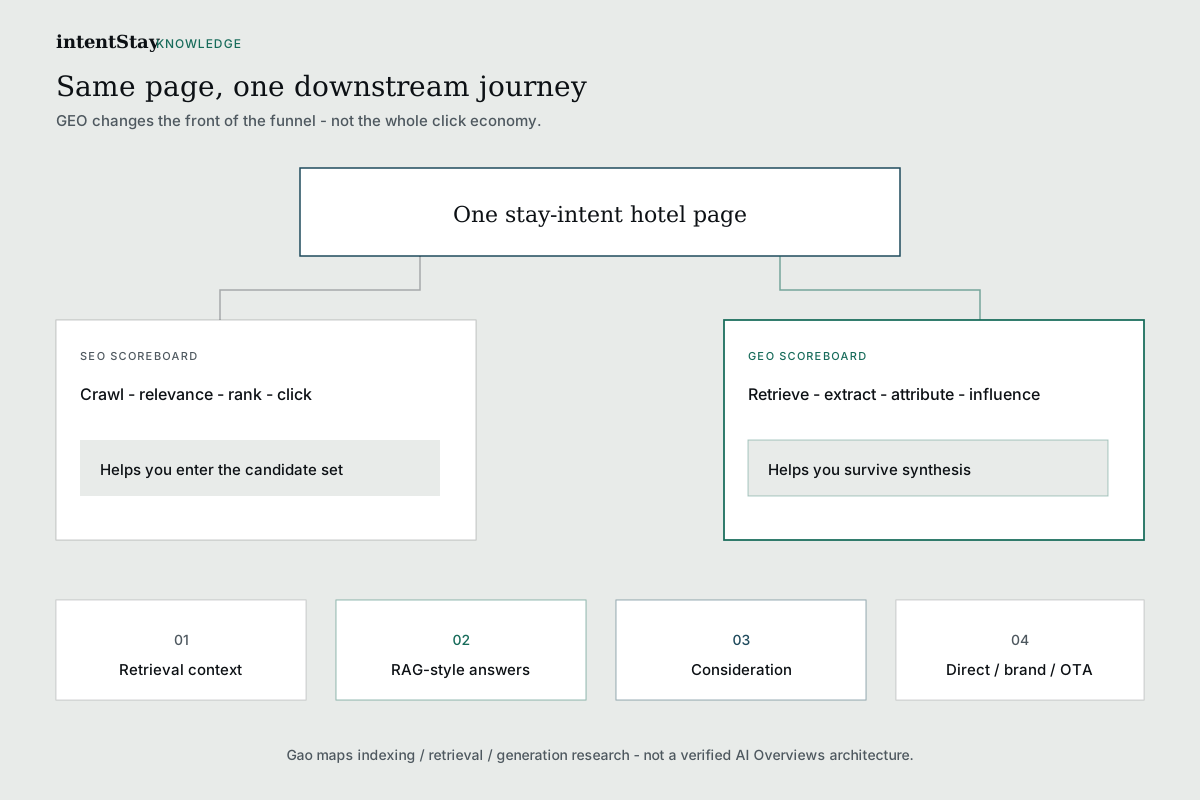
Gao and colleagues' survey (arXiv:2312.10997) is a research map of RAG, not a product teardown. Models alone can hallucinate, go stale, and hide reasoning; RAG pulls external knowledge so answers can stay fresher and, in principle, more checkable against sources.
Gao's Naive RAG sketch:
- Indexing - documents chunked, embedded, stored for retrieval.
- Retrieval - top-k relevant chunks fetched for the query.
- Generation - the model answers conditioned on those chunks.
Product UIs may also show links, chips, or names (attribution). That display layer is not a stage Gao defines - and Gao does not document Google AI Overviews' architecture. Classic crawl/intent/link work is upstream engineering so a web retriever can find you; it is not "Gao indexing." GEO craft is what happens once you are a usable source: whether a generator can lift a true sentence and whether that sentence earns prominence.
For a hotel, the same stay-intent page is the joint artifact:
Hospitality working hypothesis: we treat venue/event stay-intent URLs as the highest-leverage joint artifact for hotels. That page-type choice is editorial strategy informed by how guest asks sound at the desk - not a result reported on GEO-bench or C-SEO Bench.
| Page ingredient | SEO board | GEO board |
|---|---|---|
| Clear title / H1 aligned to a real guest ask | Relevance + CTR | Query match for retrieval |
| Structured sections / FAQ | Rankability + UX | Extractable answer capsules |
| Specific local facts (distance, timing, policy) | Usefulness signals | Quotable grounding |
| Consistent hotel · venue · event names | Entity / local SEO | Disambiguation in synthesis |
| Outbound links to primary sources | Trust / helpfulness | Corroboration trail |
| Freshness when facts change | Soft ranking / trust | Avoid stale answer risk |
| Internal links from offers / location pages | Discovery | Reinforced topical entity |
One composition. Two readouts. Liu shows that, on the 2023 engines they audited, fluent answers often lacked comprehensive or accurate citations - a verifiability failure mode, not a study of which hotel page wins retrieval. Gao surveys how RAG systems fetch external text before (or while) generating; it is not a blueprint of Google AI Overviews. Aggarwal and Puerto speak to answer-visibility metrics once you accept retrieval + synthesis as constraints - still not a hotel RCT. Separately, as editorial craft, a specific sourced stay-intent page is easier for a system to use than vague brand poetry.
What does the academic evidence say actually works - and what fails?
What Aggarwal et al. found (KDD 2024)
They tested multiple content transformations. The ones that repeatedly helped generative visibility were not 2012 SEO muscle memory:
- Statistics Addition - replace vague qualitative claims with quantitative, checkable figures.
- Quotation Addition - include relevant quotations from credible sources.
- Cite Sources - add citations to reliable sources inside the page.
- Fluency Optimization - improve readability; in their pairwise combination analysis (200-example subset), Fluency + Statistics outperformed any single top method.
Top methods landed roughly in the 30-40% range on Position-Adjusted Word Count and 15-30% on Subjective Impression in the GEO-bench evaluation they report. They also showed gains on Perplexity.ai under a constrained protocol (source text via file upload; N=200 query subset): Statistics Addition led Subjective Impression in that table (paper scores 33.9 vs baseline 24.7, about +37%) - a deployed-engine check, still not organic hotel-URL field traffic.
Keyword stuffing did not perform well on GEO-bench PAWC and was about 10% worse than baseline on Position-Adjusted Word Count in their Perplexity.ai file-upload evaluation (Subjective Impression for KS moved the other way on that table). Classic SEO folklore is not a GEO strategy.
Hotels should translate without cargo-culting: stay-intent pages are heavy on checkable local facts, so statistics, precise named entities, and outbound source citations are a plausible hospitality mapping - not fake "authority voice" adjectives. Aggarwal et al. also show method efficacy is domain-dependent; hospitality was not a measured GEO-bench domain. Bound: controlled GEO-bench and live-engine evaluations in the paper's setting, not a hotel field RCT and not a RevPAR promise. The craft is "make claims checkable and sourced," not "paste a 40% onto your forecast."
What Puerto et al. found (C-SEO Bench, NeurIPS 2025)
Puerto, Gubri, Green, Oh, and Yun (NeurIPS 2025; arXiv:2506.11097) built C-SEO Bench across question answering and product recommendation, six domains, and multi-actor adoption. The headline is sobering for anyone selling magic rewrites:
- Most current C-SEO content transformations were largely ineffective at improving citation ranking in the model's answer.
- Gains that appeared were often domain- and model-specific; many shifts canceled out.
- Improving a document's position in the LLM context (their stand-in for traditional SEO / retrieval rank) produced far larger citation-rank effects than stylistic C-SEO edits.
- As more actors adopt the same C-SEO method, average gains fall - a congested, zero-sum pattern in their adoption-rate simulations.
Bound: white-hat content transforms only; dependent variable = citation rank (not share-of-answer substance); CSE answers from proprietary models on already-retrieved English documents across six non-hotel domains. "Best SEO" in the paper means better position in the LLM context, not a measured Google organic ranking change.
The hotel synthesis (do not skip this)
SEO gets you into the room. GEO decides whether the answer can use you cleanly once you are there. Fancy phrasing tricks are a weak substitute for being retrieved - and a weak substitute for being specific.
Win eligibility first, then substance and attribution inside the answer. The next section is where the metric honesty lives - Aggarwal and Puerto are not a coin-flip.
How should hotel marketers reconcile Aggarwal and Puerto without picking a tribe?
Marketers hear two incompatible elevator pitches: "GEO methods lift visibility ~40% - stop doing SEO," and "C-SEO Bench killed GEO - just keep ranking." Both are lazy compressions.
What Aggarwal actually optimizes for. Creator-facing visibility inside generative answers: how much substance and prominence a source receives. Position-adjusted word count is the closest "how much of the briefing is you (with earlier sentences counting more)?" metric; Subjective Impression is a broader LLM-judged bundle (influence, uniqueness, click likelihood, etc.), still not Puerto-style citation rank.
What Puerto actually stress-tests. Whether popular conversational SEO transformations improve citation ranking under multi-domain, multi-actor protocols. Many text-level C-SEO edits do little for citation order; retrieval/context rank moves the needle more; gains congest as more actors copy the same trick.
| Lens | Primary question | What a win looks like | Hotel risk if you only watch this |
|---|---|---|---|
| Aggarwal (GEO impression) | How much of the answer's substance and prominence is ours? | Statistics, quotations, and citations increase share of answer fabric | Celebrate paraphrase volume while sitting low in citation chips |
| Puerto (citation rank) | Did conversational rewrites move our citation order? | Retrieval/context rank moves order more than stylistic C-SEO edits | Assume extractability never matters because rewrite tricks failed |
| Joint (this article) | Can we be retrieved and used cleanly? | Dual-board page: eligible + extractable | Buy an acronym instead of fixing the weaker board |
Why both can be true at once. Imagine two hotels retrieved into the same answer. Hotel A has a clean, statistic-rich stay-intent page. Hotel B has a vague lifestyle page but a slightly stronger retrieval position. Puerto's lens cares which source the model prefers in citation order. Aggarwal's lens cares how much of the answer's factual fabric comes from each source. Hotel A can "win substance" while Hotel B still "wins citation rank." Or neither wins if both lose retrieval to a city guide. Different gauges. Same match. Puerto notes that Aggarwal's own position-adjusted results already hinted citation-order gains were weaker than raw substance gains - the papers themselves point toward complementarity, not refutation.
What hotels should therefore do.
- Do not abandon SEO eligibility. If you are not a candidate document, Aggarwal's methods have nowhere to fire.
- Do not treat keyword stuffing as GEO. Weak on GEO-bench PAWC; about 10% worse than baseline on PAWC in Aggarwal's Perplexity.ai file-upload check (SI moved the other way).
- Treat statistics, quotations, and source citations as craft. In hospitality: walk times, entrance names, parking ranges, policy cutoffs, venue/organizer language, outbound primary sources.
- Judge progress with two readouts. Search Console discovery (SEO-ish) and a fixed prompt-panel log (practitioner GEO observation - inclusion/accuracy/prominence). Do not equate the panel with GEO-bench visibility scores.
- Expect diminishing returns on fashionable rewrites. Specific local truth congests more slowly than synonym salad.
Retrieval gets you into the context window; extractable specificity decides whether you survive synthesis as a useful, attributable source; citation order and share-of-answer substance are related but not identical victories.
Taken together - retrieval before speech, verifiability caveats, softer clicks beside summaries, and two different answer-visibility gauges - you get one operating thesis for hotel searchability, not five disconnected blog posts.
How should a hotel read the two scoreboards without lying to itself?
Hotel dashboards were built for the click era. Sessions. Organic landing pageviews. Assisted conversions. Those still matter. Booking engines still need arrivals. But Pew's July 2025 analysis of real browsing by 900 U.S. adults in March 2025 should recalibrate what "winning search" means. Pew reconstructed whether a summary appeared by re-running searches in April 2025; summary presence can change over time.
- Traditional result clicks: 8% of visits with an AI summary vs 15% without.
- Clicks on the summary's own sources: about 1% of those visits.
- Session end after a summary: 26% vs 16% without.
Seer Interactive's client Search Console / ads cohorts (not a public RCT) track softer organic CTR on informational queries that carry AI Overviews in their windows, with an Apr 2026 update describing early-2026 rebound/leveling rather than endless freefall, and still treating citation inside the Overview as material. That is a different metric family from Pew's visit next-action rates - not "the same pressure." Directional industry evidence only; not a RevPAR calculator.
So the dual scoreboard for a hotel marketing lead looks like this:
| Board | Keep watching | Add watching |
|---|---|---|
| SEO | Impressions, average position, landing-page CVR, branded vs non-branded split, technical errors | Query clusters by event/venue, cannibalization between thin location pages |
| GEO | (Often invisible in GA4 by default) | Share of answers naming you for priority prompts; citation/link presence in AI Overviews / ChatGPT / Perplexity / Gemini for a fixed prompt set; qualitative "were our facts used correctly?" |
You will not get perfect GEO analytics from a free plugin. You can run a monthly prompt panel: ten real guest questions your front desk already hears, five engines, screenshot the answer, and log inclusion / accuracy / prominence as a practitioner observation - not an Aggarwal visibility score. Crude. Honest. Better than pretending Search Console still sees the whole journey. Search Console leans SEO/retrieval; the panel is a GEO observation log. Keep both, or you will optimize for a board the guest may not be using that week.
What does a dual-scoreboard hotel page look like in practice?
Take a concrete ask:
> "Where should I stay walking distance from the arena after a late Friday show, with somewhere to park and a late checkout Saturday?"
Weak page (loses both boards, or wins the wrong one)
- Title: "Luxury Redefined Downtown"
- Body: lifestyle adjectives, spa adjectives, "steps from the action," stock skyline
- No distance, no door, no parking truth, no noise expectation, no checkout policy
- Entities drift: "the stadium," "downtown venue," "our lively district"
- SEO fate: maybe ranks for brand; loses non-brand intent to OTAs and city roundups
- GEO fate: little to extract; model borrows from a venue FAQ or Reddit thread instead
Strong page (same URL, both boards)
- Title / H1: stay near [Venue] for [Event type] - walking distance, parking, late checkout
- Opening answer capsule a model can quote (we use ~60 words as an editorial ceiling, not a researched optimum)
- Sections that match query fan-out: walk time to the correct entrance, parking reality, noise/street side, late checkout rules, morning-after transit/brunch, who this base is not for
- Numbers where numbers exist; ranges where honesty requires ranges
- Hotel name, venue name, event name spelled the same way as maps / organizer / GBP
- Links out to venue transport page, organizer lodging note, transit authority
- Last updated date that is true
- Internal links from your location and offers pages so SEO discovery is not accidental
Notice what you did not need: a second "AI version" of the site. You needed editorial courage - specificity over poetry - and outbound primary sources the way Aggarwal's Cite Sources method rewards.
Google's February 2023 AI-content guidance and March 2024 scaled-content-abuse policy are method-agnostic: helpful, original, people-first pages versus scaled unoriginal pages meant to manipulate rankings. A thousand thin "hotels near X" husks can damage the SEO board even if an LLM wrote them fluently. A smaller set of answer-shaped, locally true pages can strengthen both boards. Quality is the shared currency.
How do you audit one URL on both scoreboards?
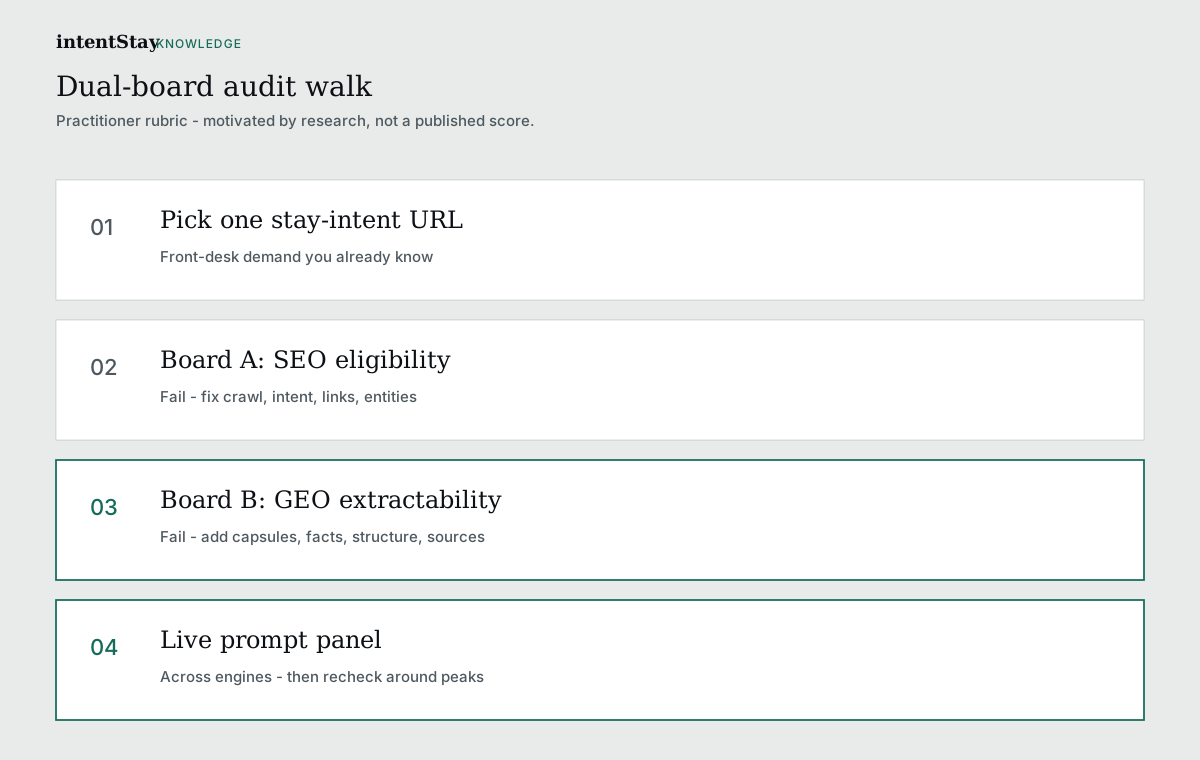
Method note: The 0-2 scores, /14 totals, and band names below are a practitioner checklist for prioritizing work. They are not from GEO-bench or C-SEO Bench, have no published reliability study, and have not been shown to predict hotel citation rates or bookings. Use them to structure judgment - not as scientific measurement.
Apply it to one URL your front desk already fields questions about. Score each row 0 / 1 / 2 as a prioritization aid, not a scientific instrument.
How scoring works
| Score | Meaning | Hotel translation |
|---|---|---|
| 0 | Weak / failing | A skeptical guest services manager would reject this as unusable |
| 1 | Acceptable / partial | Present but incomplete, vague, or easy to misread |
| 2 | Strong | Clear, checkable, and ready for a human or a model to quote |
Board A and Board B are each 7 checks × 0-2 = /14 (combined /28). Do not average them into one vanity number. A 12/14 on A and 4/14 on B is a different patient from the reverse.
Board A - SEO eligibility (can you enter the candidate set?)
| # | Check | 0 Weak | 1 Acceptable | 2 Strong | Your score |
|---|---|---|---|---|---|
| A1 | Index / canonical health | Blocked or duplicated | Mostly clean | Clean + intentional | |
| A2 | Title/H1 match a real guest ask | Brand poetry | Partial | Exact stay-intent | |
| A3 | Internal links from relevant pages | Orphan | A few | Clear pathway | |
| A4 | Competes for a specific query cluster | Vague | Some overlap | Owns a local cluster | |
| A5 | Entity consistency with GBP/maps | Drift | Mostly aligned | Aligned | |
| A6 | Mobile / speed / CLS not embarrassing | Broken | OK | Solid | |
| A7 | Unique value vs OTA/city guide | Thin rewrite | Some local add | Front-desk truth | |
| Board A total | /14 |
Board B - GEO extractability (can an answer use you?)
| # | Check | 0 Weak | 1 Acceptable | 2 Strong | Your score |
|---|---|---|---|---|---|
| B1 | Opening capsule answers the H1 question | No | Partial | Quotable opening (we use ~60 words as an editorial ceiling, not a researched optimum) | |
| B2 | Checkable facts (distance/time/policy) | Adjectives | A few | Dense + bounded | |
| B3 | Sections map to query fan-out | Wall of text | Some H2s | Spoke coverage | |
| B4 | Outbound citations to primary sources | None | Token links | Real corroboration | |
| B5 | Stale-risk facts dated / owned | Eternal claims | Sometimes | Freshness discipline | |
| B6 | Skeptical GM trust test | No | Maybe | Yes - night audit would sign it | |
| B7 | Live engine test: named or used correctly | Absent / mangled | Occasional | Repeated inclusion | |
| Board B total | /14 |
Dual score bands
| Board A | Board B | Band name | What it means | First move |
|---|---|---|---|---|
| 11-14 | 11-14 | Dual-ready | Eligible and extractable | Maintain; recheck around peaks; earn one external echo |
| 11-14 | 0-7 | Ranked but mute | Impressions without answer inclusion | Add capsules, facts, structure, citations; stop synonym stuffing |
| 0-7 | 11-14 | Beautiful orphan | Clean briefing nobody retrieves | Fix crawl, intent, links, entities first |
| 0-7 | 0-7 | Not in the game | Weak discovery and weak extractability | Pick one demand anchor; rebuild one honest page |
| 8-10 | 8-10 | Competitive mid | In the fight, not yet the default cite | Raise the two lowest rows on each board this sprint |
| Any | B7 = 0 | Unverified | Desk score without live engine check | Run the prompt panel before declaring GEO progress |
Reading the score
- Ranked but mute (strong A, weak B):
Impressions without answer inclusion. Add facts, structure, citations; stop stuffing synonyms.
- Beautiful orphan (weak A, strong B): Clean briefing nobody retrieves. Fix discovery and internal linking first (operational inference - Puerto measured citation order given retrieved context, not Google discovery).
- Not in the game (weak A, weak B): Do not "do GEO." Pick one demand anchor and build one honest page.
- Dual-ready (strong A, strong B): Maintain; recheck around peaks; pitch one earned surface so you are not a lone claim.
What does a practical 30-day dual-scoreboard walk look like?
Nothing in Aggarwal, Puerto, Liu, Gao, or Pew specifies this calendar. Skip or stretch weeks; do not treat Days 15-22 as "the GEO treatment arm."
Answer capsule: Example 30-day operating calendar - not a validated trial protocol. Week 1 baseline prompts + demand anchor; Week 2 eligibility work on one URL; Week 3 extractability edits inspired by Aggarwal-style specificity (not keyword stuffing); Week 4 re-test and one earned corroboration. Cadence and sample sizes are craft choices. Do not scale thin pages.
Days 1-7 - Baseline both boards
List ten questions guests already ask. Run them through Google (note AI Overview), ChatGPT, Gemini, and Perplexity. Record: named, linked, paraphrased, ignored, or misrepresented? In Search Console, pull the non-brand query cluster. Record a crude GEO observation (not an Aggarwal metric): did our facts appear correctly with our name? Score SEO-ish discovery as "do we appear for the demand cluster at all?"
Days 8-14 - Win eligibility (SEO board)
Choose one URL. Kill soft duplicates. Align title/H1 to the guest ask. Add internal links from location and offers. Align venue/event naming with GBP and the organizer. Fix anything that would keep a web retriever from treating the page as a candidate. Puerto shows in-context rank among retrieved documents dominates citation order versus stylistic C-SEO edits; use that as a humility check, not as proof that this week's crawl/link fixes are what their "Best SEO" condition measured.
Days 15-22 - Win extractability (GEO board)
Rewrite toward Aggarwal's stronger moves - not keyword stuffing: a true opening capsule; quantitative local facts; real quotations/citations to venue, organizer, or transit sources; H2 spokes with answer-first paragraphs; clear boundaries for who this base is wrong for. Prefer checkable claims over unsupported superlatives (editorial craft; not a Liu prescription). Liu's finding is about engine citation support, not adjective policy.
Days 23-30 - Re-test and corroborate
Re-run the same ten prompts. Score inclusion and accuracy. Pursue one external echo: venue visitor page, race travel partners, city tourism editor, planner newsletter. A lonely brand claim is a fragile retrieval target. Do not finish by publishing forty programmatic near-duplicates - Google's scaled content abuse policy treats unoriginal ranking-manipulation pages as spam regardless of production method, and Puerto's adoption curves warn that when many actors apply the same C-SEO transform, average citation-rank gains collapse - a reason not to scale identical rewrite templates.
How should a skeptical GM decide whether to fund "GEO" at all?
Commercial recommendation (intentStay): The fund / do-not-fund list and walkthrough CTA below are our operating advice. They are not entailed findings from Aggarwal, Puerto, Liu, Gao, or Pew.
Fund this
- One (then a few) stay-intent pages tied to demand the front desk already knows is real.
- Technical and internal-linking work that gets those pages into the candidate set.
- Editorial work: checkable facts, structure, outbound corroboration.
- A monthly prompt panel so leadership sees inclusion and accuracy without waiting for perfect analytics.
- One serious earned surface per priority demand anchor.
Do not fund this
- A rebranded SEO retainer that cannot explain Aggarwal vs Puerto metric differences.
- "Separate AI websites" that create thin duplicates.
- Keyword stuffing so robots "understand" you.
- Claims that Aggarwal's ~40% visibility lifts equal hotel booking lift. Different setting, metric, product.
- Black-box "we get you into ChatGPT" promises with no public page you control as the unit of work. If the mechanism cannot be described as retrieve → extract → attribute on owned content, it is a mood, not a strategy.
The GM's one-line brief
We are not buying an acronym. We are buying pages a guest, a crawler, and a retriever can all use without squinting, and we will measure both boards.
Optional: request a walkthrough if you want that dual-board map on your calendar and competitive set - commercial offer, not a paper finding.
What should a smart hotel marketer believe from here?
Shown in the cited work (lab / panel / survey bounds): Aggarwal - substance-rich methods can lift answer-level visibility metrics in GEO-bench settings; keyword stuffing fails on PAWC. Puerto - among already-retrieved docs, earlier LLM-context position beats most white-hat rewrite tricks for citation order; gains congest when copied. Liu - fluent answers on the 2023 engines they audited often lacked full citation support. Gao - RAG research often places retrieval upstream of generation. Pew - traditional clicks are rarer in visits with an AI summary than without (8% vs 15%). Google - quality, not production method.
Fair inference (not a hotel RCT): SEO eligibility and GEO extractability are complementary readouts on one page; click dashboards under-count journeys that resolve in answers; the "SEO is dead / GEO is fake" fight is mostly vendor theater.
Operating advice (intentStay):
- One page, two scoreboards - not an "AI site" beside an "SEO site."
- Eligibility before extractability - Board A before Board B.
- Substance ≠ citation order - Aggarwal gains do not automatically reorder Puerto's stack.
- Specificity is the shared currency - facts, entities, policies, outbound sources; not keyword stuffing.
- Clicks remain necessary and no longer sufficient - keep conversion paths; add inclusion/accuracy monthly.
- Earned corroboration stabilizes retrieval - owned briefings need external echoes.
Operating opinion:
Your scarce asset is not a new acronym. It is a small library of stay-intent pages that a guest, a crawler, and a retriever can all use without squinting. Same page. Two scoreboards. One standard of truthfulness.
What questions do hotel marketers ask most?
Did Liu et al. measure ChatGPT Search or Google AI Overviews?
No. The 51.5% recall / 74.5% precision figures come from a 2023 human audit of Bing Chat, NeevaAI, perplexity.ai, and YouChat. Use them as a verifiability warning, not as a score for today's ChatGPT Search or AI Overviews.
Do Aggarwal and Puerto refute each other?
No. Different primary metrics: share-of-answer substance versus citation ranking. A source can gain answer substance without leaping citation order. Read them as complementary constraints on the same dual-board page.
Is GEO replacing SEO for hotels?
No. GEO adds an answer-layer scoreboard. Puerto et al. find that, among documents already in the model context, putting a source earlier in that context outweighs most white-hat conversational rewrite tricks for citation order. That is not the same measurement as "getting indexed by Google." Treat classic eligibility work as upstream engineering; do not cite C-SEO Bench as a crawl/index experiment.
If Aggarwal showed ~40% visibility lifts, why does C-SEO Bench look pessimistic?
Different primary metrics. Aggarwal emphasizes share-of-answer substance; Puerto emphasizes citation ranking under multi-domain, multi-actor protocols. A source can gain answer substance without leaping citation order. Complementary constraints - not proof either paper "won."
Should we stuff keywords so AI "understands" our hotel?
No. Keyword stuffing was weak on GEO-bench PAWC and about 10% worse than baseline on PAWC in Aggarwal et al.'s Perplexity.ai check (file-upload protocol). It is not a GEO strategy. Specific facts, quotations, and source citations outperformed stuffing in their GEO-bench methods. Stuffing also risks classic spam patterns. Separately, Puerto finds C-SEO gains congest when many actors copy the same transform - do not read that as a Keyword Stuffing cell in C-SEO Bench.
Do we need separate pages for SEO and GEO?
Almost never. Build one stay-intent page that is crawlable and answer-shaped. Separate "AI pages" usually create duplication, thinness, or brand drift.
What metrics prove GEO is working if clicks are down?
Run a fixed prompt panel monthly: inclusion, accuracy, and prominence across engines. Pair with Search Console for discovery. Pew's 8% vs 15% traditional-click gap is the caution light.
Will AI-written hotel pages help us on both boards?
Only if the result is original, locally true, and people-first. Google judges quality, not "was AI used?" Thin automated location pages can harm SEO eligibility and give GEO nothing worth citing.
What is the highest-leverage dual-board page to improve first?
Our recommendation, not a paper finding: usually a venue- or event-anchored stay guide for demand your front desk already knows is real - natural statistics, clear entities, and query fan-out where both boards can improve together.
Can a small independent hotel beat a chain on these scoreboards?
Locally, a precise independent page can out-specify a vague chain template on extractability - that is a craft claim. Aggarwal's lab discussion only suggests that, among sources already retrieved, GEO-style improvements can help lower-ranked sources in their multi-source setup; it does not show independents beating chains in market. You still need accuracy, freshness, retrieval eligibility, and external corroboration.
Does getting cited in AI answers guarantee more bookings?
No. Neither Aggarwal nor Puerto nor Pew measures hotel RevPAR. Citation can shape consideration; booking still travels through brand search, OTAs, direct paths, rate, and availability. Dual-board work is searchability craft, not a revenue calculator.
Which sources underpin these claims?
- Pranjal Aggarwal, Vishvak Murahari, Tanmay Rajpurohit, Ashwin Kalyan, Karthik Narasimhan & Ameet Deshpande, GEO: Generative Engine Optimization, KDD 2024 (arXiv:2311.09735). https://arxiv.org/abs/2311.09735 https://doi.org/10.1145/3637528.3671900
- Haritz Puerto, Martin Gubri, Tommaso Green, Seong Joon Oh & Sangdoo Yun, C-SEO Bench: Does Conversational SEO Work?, NeurIPS 2025 Datasets and Benchmarks Track (arXiv:2506.11097). https://arxiv.org/abs/2506.11097
- Nelson F. Liu, Tianyi Zhang & Percy Liang, Evaluating Verifiability in Generative Search Engines, Findings of EMNLP 2023 (arXiv:2304.09848). https://arxiv.org/abs/2304.09848 https://aclanthology.org/2023.findings-emnlp.467/
- Yunfan Gao et al., Retrieval-Augmented Generation for Large Language Models: A Survey (arXiv:2312.10997). https://arxiv.org/abs/2312.10997
- Athena Chapekis & Anna Lieb, Google users are less likely to click on links when an AI summary appears in the results, Pew Research Center, 22 Jul 2025. https://www.pewresearch.org/short-reads/2025/07/22/google-users-are-less-likely-to-click-on-links-when-an-ai-summary-appears-in-the-results/
- Google Search Central, Creating helpful, reliable, people-first content. https://developers.google.com/search/docs/fundamentals/creating-helpful-content
- Google Search Central Blog, Google Search’s guidance about AI-generated content, Feb 2023. https://developers.google.com/search/blog/2023/02/google-search-and-ai-content
- Google Search Central, Spam policies for Google web search (scaled content abuse). https://developers.google.com/search/docs/essentials/spam-policies
- Google Search Central Blog, What web creators should know about our March 2024 core update and new spam policies, Mar 2024. https://developers.google.com/search/blog/2024/03/core-update-spam-policies
- Seer Interactive (industry research; client-data study, not a public randomized sample), AIO Impact on Google CTR: September 2025 Update. https://www.seerinteractive.com/insights/aio-impact-on-google-ctr-september-2025-update
- Seer Interactive (industry research; expanded multi-intent cohort), AIO Impact on Google CTR: 2026 Update, 24 Apr 2026. https://www.seerinteractive.com/insights/aio-impact-on-google-ctr-2026-update
Companion (not a primary source for the claims above): How hotels get cited in ChatGPT & Google AI Overviews — the citation-funnel companion in this Knowledge cluster.
Searchability for hospitality, intentStay. Optional next step if you want a dual-board map on your URLs: request a walkthrough.
Want to see how this maps to your calendar?
About thirty minutes. Your events, your voice, your competitive set. Nothing mystical - just searchability where stay decisions actually form.
Request a walkthrough